
Cuando dije que ganaban los dos, la reacción más generosa que recibí fue que estaba desconectado. Las encuestas decían otra cosa, Keiko ya había perdido tres veces y De la Espriella era un abogado sin partido. Lo publiqué de todos modos, desde Hawái, antes de que ocurriera cualquiera de las dos elecciones.
Ganaron los dos. Y ahora le voy a mostrar el número que me hizo estar seguro, uno que nadie en México ha puesto en portada.
En Perú, Keiko Fujimori ganó la presidencia por 49,641 votos. Ese fue el margen final sobre 18 millones 397 mil sufragios válidos. Ahora vea este otro número: entre los peruanos que votaron fuera del Perú, Fujimori obtuvo 195,388 votos contra 113,733 de Roberto Sánchez. Una diferencia de 81,655 votos.
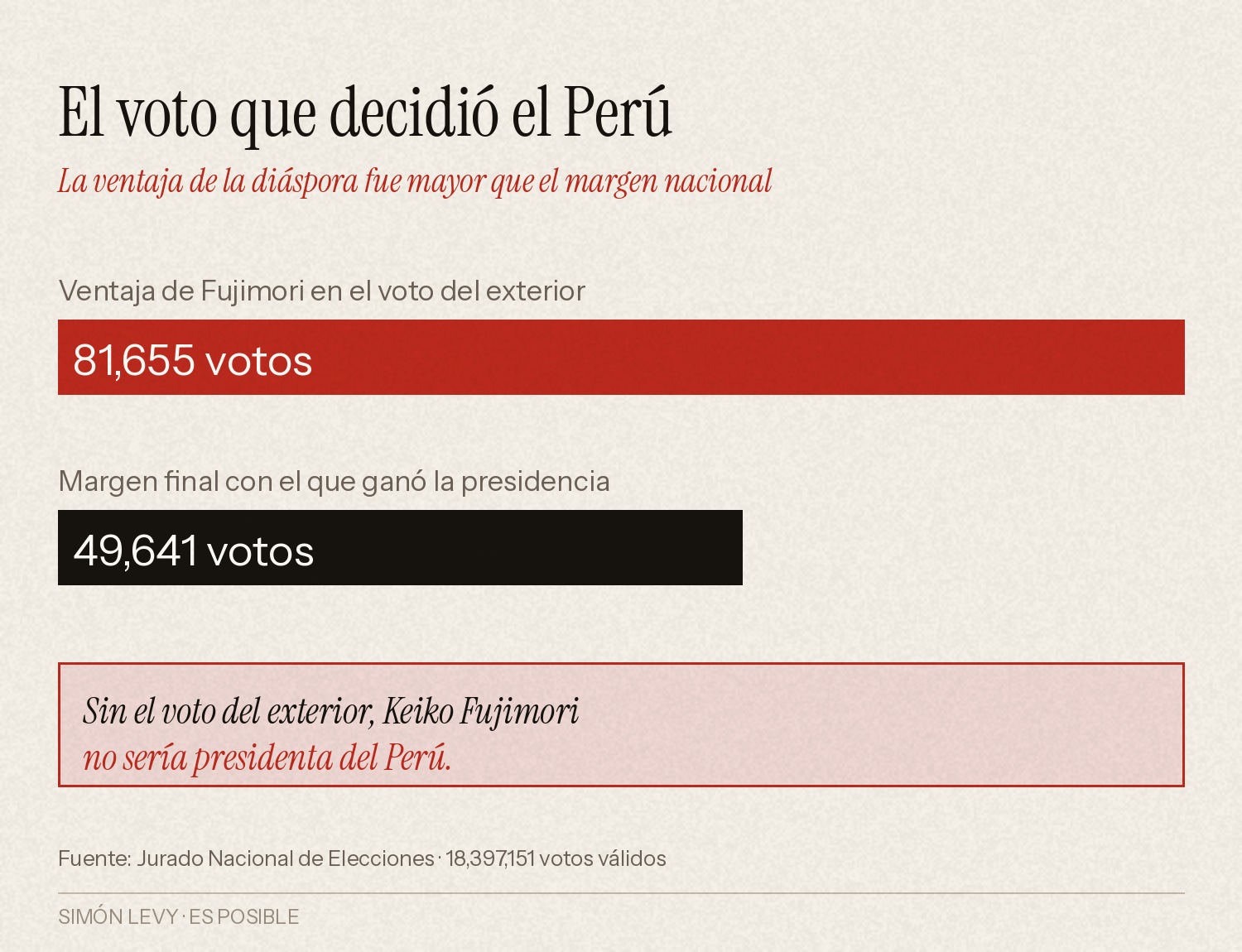
Léalo otra vez, porque es la frase que resume todo. La presidencia del Perú no se decidió en el Perú. Se decidió en consulados de Miami, Madrid, Santiago, Buenos Aires y Nueva York, entre gente que no vive ahí, que no va a pagar los impuestos de ese gobierno y que en muchos casos no pisa el país desde hace años.
Y en Colombia pasó exactamente lo mismo. De la Espriella ganó por 249 mil votos. En los consulados obtuvo 390,949 sufragios, el 63.77 por ciento. Ese bloque, solo, explica la mayor parte de su margen.
Ahora bien, si esto fuera nada más el voto de afuera, sería una anécdota. No lo es. Lo que hay detrás es una máquina de campo que se construyó durante años, provincia por provincia, departamento por departamento, y que hizo algo que la derecha latinoamericana no había logrado nunca: ganarle a la izquierda en su propio terreno.
Le doy tres piezas del rompecabezas, y con eso paro.
Uno. En un solo distrito de Lima, San Isidro, Fujimori pasó del 8.7 por ciento en la primera vuelta al 84.2 por ciento en la segunda. Setenta y cinco puntos de salto en cinco semanas. Eso no ocurre solo.
Dos. En Colombia, el departamento que decidió la elección fue Antioquia, donde De la Espriella sacó 2 millones 185 mil votos, el 64.42 por ciento. Pero perdió en Córdoba, el departamento de donde es su propia familia.
Tres, y este es el que rompe todos los análisis que ha leído. Los departamentos colombianos más golpeados por el narcotráfico y la violencia armada, Cauca, Nariño y Chocó, no votaron por el candidato de mano dura. Votaron por la izquierda, y con márgenes aplastantes: Cepeda sacó 75.64 por ciento en Cauca y 81.37 por ciento en Chocó.
Aquí paro. Lo que sigue es el desarme completo: las cinco lecciones del método, cómo se trabajó cada región del Perú y cada departamento de Colombia, cómo operó el narcotráfico en el mapa electoral y por qué su efecto es el contrario del que todos suponen, cómo Marco Rubio desmontó al Foro de São Paulo en seis meses sin disparar un tiro, y la cuenta en dólares del mercado que Perú le está quitando a México.
When I said both would win, the most generous reaction I got was that I was disconnected. The polls said otherwise, Keiko had already lost three times and De la Espriella was a lawyer with no party. I published it anyway, from Hawaii, before either election happened.
Both won. And now I will show you the number that made me certain, one nobody in Mexico has put on a front page.
In Peru, Keiko Fujimori won the presidency by 49,641 votes. That was the final margin out of 18,397,151 valid ballots. Now look at this other number: among Peruvians who voted outside Peru, Fujimori took 195,388 votes against 113,733 for Roberto Sánchez. A difference of 81,655 votes.
Read it again, because that sentence sums up everything. Peru's presidency was not decided in Peru. It was decided in consulates in Miami, Madrid, Santiago, Buenos Aires and New York, among people who do not live there, who will not pay that government's taxes and who in many cases have not set foot in the country for years.
And in Colombia exactly the same thing happened. De la Espriella won by 249,000 votes. In the consulates he took 390,949 ballots, 63.77 percent. That bloc alone explains most of his margin.
Now, if this were only the overseas vote it would be an anecdote. It is not. Behind it lies a ground machine built over years, province by province, department by department, that achieved something the Latin American right had never managed: beating the left on its own terrain.
Three pieces of the puzzle, and then I stop.
One. In a single Lima district, San Isidro, Fujimori went from 8.7 percent in the first round to 84.2 percent in the second. Seventy-five points of movement in five weeks. That does not happen by itself.
Two. In Colombia, the department that decided the election was Antioquia, where De la Espriella took 2,185,834 votes, 64.42 percent. But he lost Córdoba, the department his own family comes from.
Three, and this one breaks every analysis you have read. The Colombian departments hit hardest by drug trafficking and armed violence, Cauca, Nariño and Chocó, did not vote for the hardline candidate. They voted for the left, by crushing margins: Cepeda took 75.64 percent in Cauca and 81.37 percent in Chocó.
Here I stop. What follows is the full breakdown: the five lessons of the method, how each Peruvian region and each Colombian department was worked, how drug trafficking operated on the electoral map and why its effect is the opposite of what everyone assumes, how Marco Rubio dismantled the São Paulo Forum in six months without firing a shot, and the dollar accounting of the market Peru is taking from Mexico.
Lo que sigue no lo va a leer en ningún otro lado
Detrás de este punto está la respuesta completa a la pregunta que ningún noticiero mexicano está haciendo: ¿qué le cuesta a México que Perú y Colombia cambien de bando en diez días? Con cifras de aduana, producto por producto.
Además, dos herramientas que construí para que lo vea usted mismo:
- El mapa región por región · Lima, la costa norte, el sur andino, Antioquia, la Costa Caribe y por qué perdió Córdoba
- Cómo operó el narco en el mapa electoral · y por qué su efecto es exactamente el contrario del que todos suponen
- Los cuatro movimientos de Marco Rubio contra el Foro de São Paulo, con fechas
- Las cinco lecciones interactivas · qué hacía la izquierda, qué cambió la derecha y qué debe leer México de cada una
- Los cuatro frentes de Keiko · gobernabilidad, el puerto chino, el cobre y la legitimidad, con el nivel de dificultad de cada uno
- El manual mexicano · las cinco lecciones traducidas a instrucciones concretas contra Morena, con el calendario de 2027
- El tablero del realineamiento · país por país, la fecha en que cambió y qué implica para México
Y todo lo demás: el puerto chino de Chancay que Keiko hereda y por qué no puede romper el contrato, qué le pasa al Foro de São Paulo al perder dos capitales en diez días, la tabla de mercado producto por producto en dólares, el arancel que Estados Unidos acaba de subirle a Perú y por qué le compra tiempo a México, y qué haría yo si mi dinero estuviera en juego.
No lo escribió una redacción. Lo escribí yo, cruzando resultados electorales, fallos judiciales y registros de aduana. Acceso permanente, en español e inglés, con audio completo de 64 minutos.
$4.99 USD · una sola vez
What follows you will not read anywhere else
Behind this point sits the full answer to the question no Mexican newscast is asking: what does it cost Mexico that Peru and Colombia switch sides in ten days? With customs figures, product by product.
Plus two tools I built so you can see it yourself:
- The map region by region · Lima, the north coast, the southern Andes, Antioquia, the Caribbean Coast and why he lost Córdoba
- How the narco operated on the electoral map · and why its effect is the exact opposite of what everyone assumes
- Marco Rubio's four moves against the São Paulo Forum, with dates
- The five interactive lessons · what the left was doing, what the right changed and what Mexico should read from each
- Keiko's four fronts · governability, the Chinese port, copper and legitimacy, with each one's difficulty level
- The Mexican playbook · the five lessons translated into concrete instructions against Morena, with the 2027 calendar
- The realignment board · country by country, the date it changed and what it implies for Mexico
And everything else: the Chancay Chinese port Keiko inherits and why she cannot break the contract, what happens to the São Paulo Forum when it loses two capitals in ten days, the market table product by product in dollars, the tariff the United States just raised on Peru and why it buys Mexico time, and what I would do if my money were at stake.
No newsroom wrote this. I wrote it, cross-referencing electoral results, court rulings and customs records. Permanent access, Spanish and English, with the full 64 minute audio.
$4.99 USD · one time
El mapa real: dónde se ganó cada país, región por regiónThe real map: where each country was won, region by region
Lima entregó un millón setecientos treinta y dos mil votos de ventaja. Tumbes fue el mejor porcentaje del país. San Martín se definió por dos mil seiscientos treinta y tres sufragios. Antioquia decidió Colombia con dos millones ciento ochenta y cinco mil. Y en los departamentos donde manda el narco ganó la izquierda con setenta y cinco y ochenta y un por ciento. Todo eso, con el mapa completo de cada región y de cada departamento, más los cuatro movimientos con los que se desmontó al Foro de São Paulo.Lima delivered a 1,732,000-vote advantage. Tumbes was the best percentage in the country. San Martín was decided by 2,633 ballots. Antioquia decided Colombia with 2,185,000. And in the departments the narco controls, the left won with seventy-five and eighty-one percent. All of it, with the full map of every region and department, plus the four moves that dismantled the São Paulo Forum. 🔒
█████ ██████ ████████ ██ ███████ ████████ █████ ██████████ ███ ████████ ██████ ████ █████████ ██████████ ████ ██████ ███████ ████████ █████ ██████ ████████ ██ ███████ ████████ █████.
██████ ████ █████████ ██████████ ████ ██████ ███████ ████████ █████ ██████ ████████ ██ ███████ ████████ █████ ██████████ ███ ████████ ██████ ████ █████████ ██████████.
Desbloquea la investigación completaUnlock the full investigation
Pago único. Acceso permanente en este dispositivo.One-time payment. Permanent access on this device.
Desbloquear · $4.99 USDUnlock · $4.99 USDVerifícalo tú mismo · Fuentes públicasVerify it yourself · Public sources
- Jurado Nacional de Elecciones del Perú · Proclamación del 3 de julio de 2026
- Registraduría Nacional de Colombia · Resultados de la segunda vuelta del 21 de junio de 2026
- Asociación de Exportadores del Perú · Cifras de agroexportación a Estados Unidos
- Ositrán · Regulador de infraestructura de transporte del Perú (caso Chancay)
- Representante Comercial de Estados Unidos · Tratado de Libre Comercio con Perú
Investigación y análisis: Simón Levy. Publicado por Es Posible. Apoya este trabajo en Research and analysis: Simón Levy. Published by Es Posible. Support this work at patreon.com/SimonLevyMX · diario.simonlevy.mx